
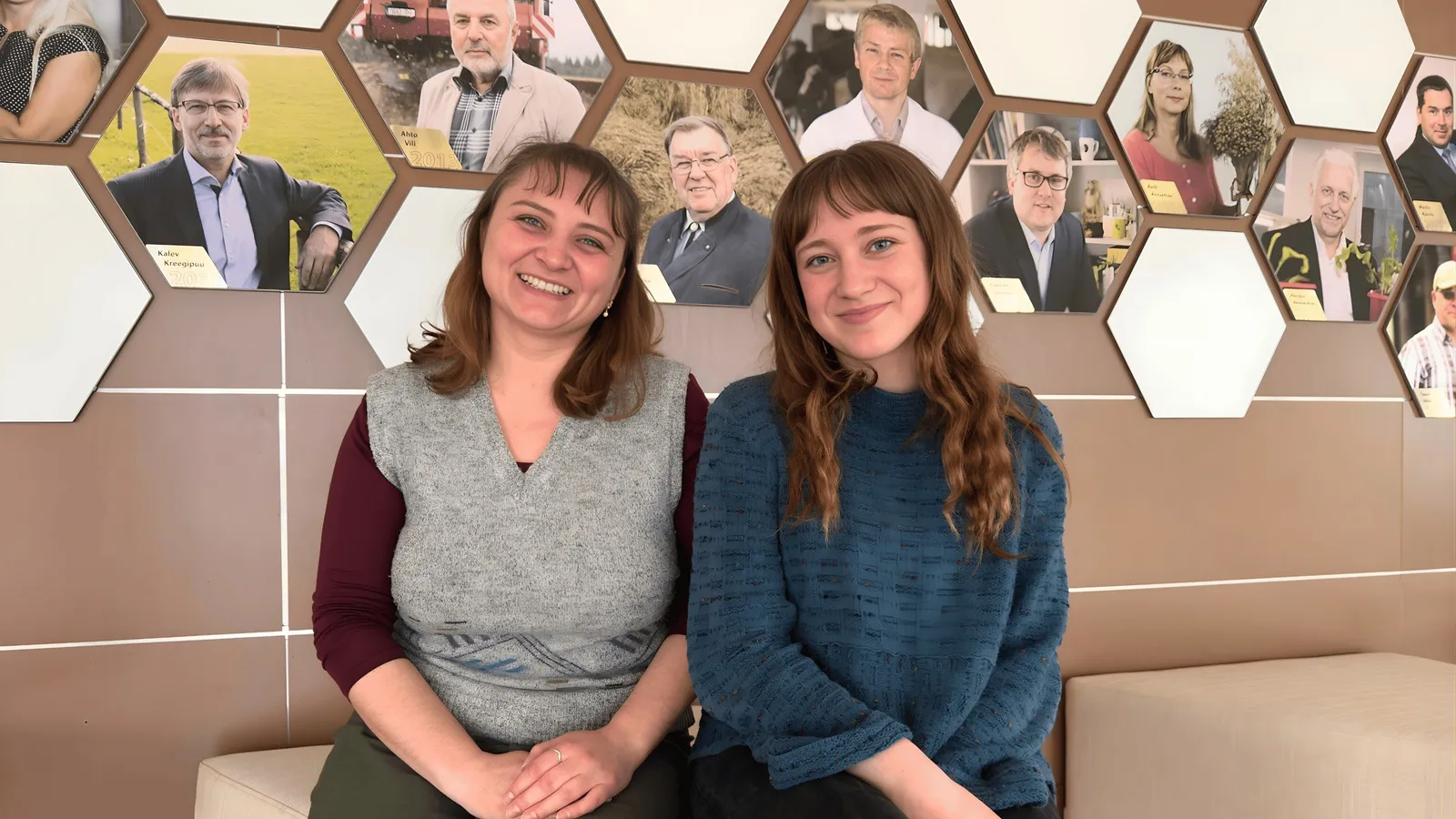
Helena Valvur and Lily Black are first-year students in the Environmental Governance and Adaptation to Climate Change (ENGO) Master’s programme, jointly offered by the Estonian University of Life Sciences and the University of Tartu. Coming from different backgrounds - and even different continents - they share a common interest in understanding and addressing environmental challenges.
Different paths to ENGO
For Helena, who is half Estonian, the decision to study in Estonia was partly personal. Encouraged by her sister, she began exploring study options in Tartu and came across the ENGO programme.
“I knew I wanted to do a Master’s, but I wasn’t entirely sure in what,” she says. “When I found this programme, it just felt like something I was really interested in and passionate about.”
Her academic background is not directly linked to environmental studies – having previously studied astronomy – yet she found that ENGO welcomes diverse perspectives.
Lily, originally from the United States, followed a different path. With a background in geoscience and an Estonian partner, she was already considering Estonia as a study destination. Discovering ENGO felt like a natural continuation of her studies.
“It was exactly what I was looking for,” she explains. “It connects really well with my previous studies, but also opens up new directions.”
A programme that exceeded expectations
Both students admit that the programme turned out to be somewhat different from what they initially expected in a positive way. While they anticipated a strongly science-based curriculum, they found a balanced combination of science and policy, enriched by elements of social sciences and humanities.
“I didn’t expect it to be as focused on political theory and climate policy,” Helena says. “But I’ve really enjoyed that side of it, because it adds a lot of depth.”
Learning beyond the classroom
Another highlight of the programme has been the practical component. Field trips, site visits, and applied projects allow students to experience environmental topics in real-life contexts.
“It’s not just sitting in a classroom,” Lily notes. “You actually get to see how things work in practice, which makes the learning much more meaningful.”
Studying across two universities
The structure of the programme is split between two universities and offers additional flexibility and opportunities. Students can take courses at both institutions, meet a wider range of people, and benefit from different academic perspectives.
“I really like that it’s at two universities,” Lily says. “You get more options, more connections, and a broader experience overall.”
At the same time, the relatively small size of the programme creates a close-knit learning environment.
“There are only a few of us in the cohort,” Helena explains. “You really get to know your professors and classmates, and it makes it easier to ask for help and engage in discussions.”
Student life in Tartu
Student life in Tartu has also played an important role in their experience. The city’s compact size, strong student culture, and proximity to nature create a unique balance between academic life and everyday wellbeing.
“It definitely feels like a student city,” Helena says. “There are lots of events and opportunities, but it’s also calm and easy to navigate.”
For Lily, coming from a larger urban area in the United States, Tartu offers a familiar yet refreshing environment.
“I like that everything is within walking distance,” she says. “You don’t need a car, and you can easily explore the city and nature around it.”
Life beyond studies
Outside of their studies, both students have embraced new activities from dance classes and traditional Estonian folk dancing to hiking and orienteering.
The programme also offers a wide range of additional opportunities, including summer schools, internships, and international mobility options. Both Helena and Lily have already applied for summer schools and internships, including opportunities with environmental institutions and international organisations.
Despite these possibilities, they see their current studies in Estonia as an international experience in itself.
“This is already our study abroad,” Helena says with a smile.
Looking ahead
Looking ahead, both students appreciate the flexibility the programme provides when it comes to future career paths.
“It opens a lot of doors,” Helena explains. “You’re not being trained for just one job, you’re gaining a foundation for many different roles.”
She is currently considering paths such as environmental consulting or urban climate adaptation, while Lily is exploring opportunities both in the United States and potentially in Estonia.
A new way of thinking
What they both agree on is that ENGO equips students with not only knowledge, but also a way of thinking.
“You start seeing things differently,” Lily says. “Sometimes I read about climate issues and realise that we were just talking about this in class.”
Advice to future students
For prospective students, their advice is simple: be open, curious, and ready to step outside your comfort zone.
With its interdisciplinary approach, international environment, and strong connection to real-world challenges, ENGO offers more than just a degree: it offers a platform to explore, grow, and shape your future in the environmental field.
