
On 10 November, Chanaka Nishan Premathilaka Egodawatte Gedara defended his doctoral thesis at the Estonian University of Life Sciences, entitled “Extracellular vesicles as markers of gut health and host–pathogen interactions”. His research explored new approaches to assessing intestinal health and parasitic infections in animals.
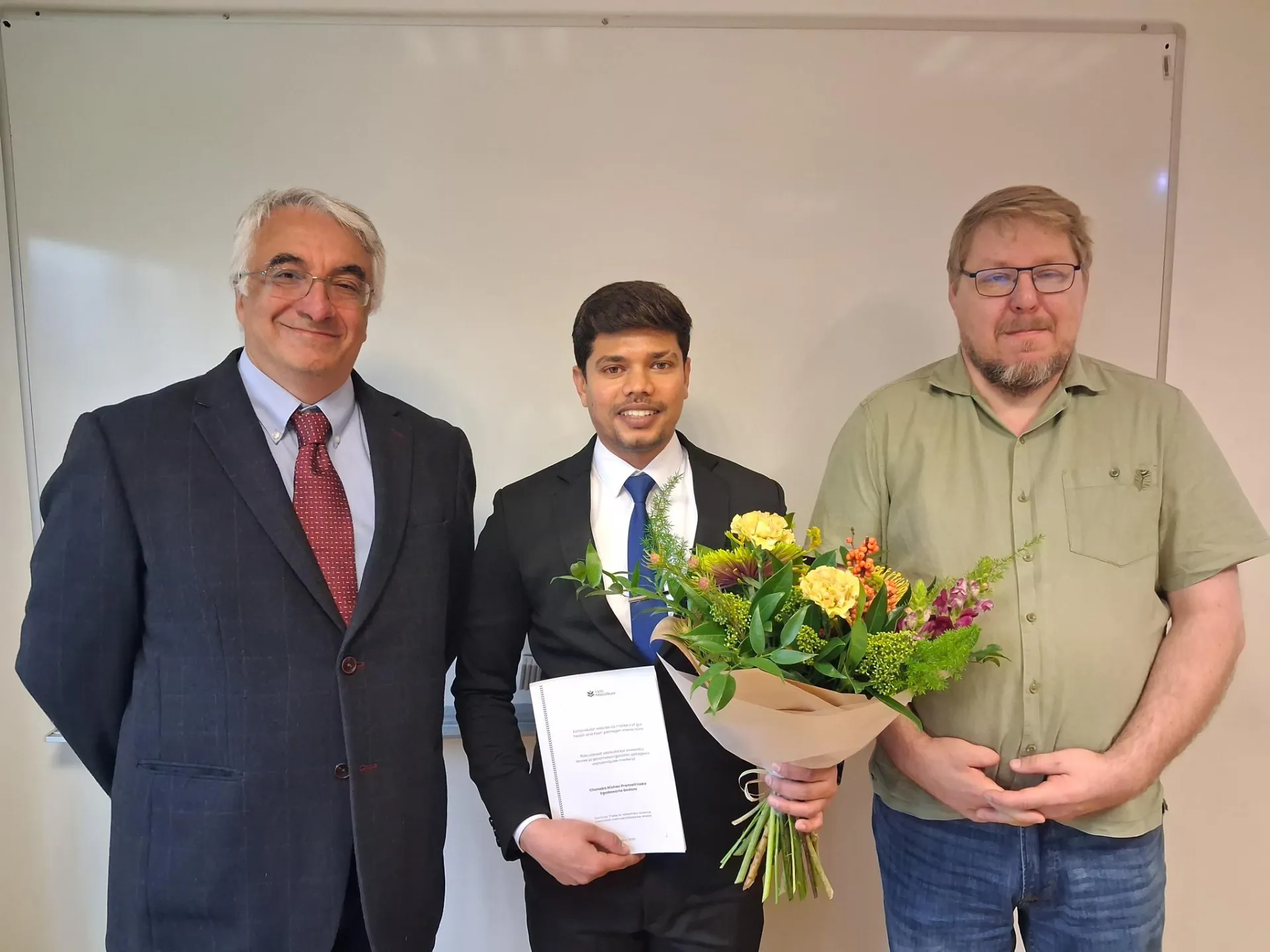
The doctoral thesis was supervised by Professor Alireza Fazeli, Professor Toomas Orro and Senior Researcher Suranga Pradeep Kodithuwakku Kankanamge. The opponent was Professor Katia Cappelli from the University of Perugia, Italy.
Gastrointestinal infections pose a significant threat to animal health and productivity. Recent studies have shown that the intestine, microorganisms, and pathogens communicate through extracellular vesicles. These tiny particles carry various molecules and provide information about intestinal health. As extracellular vesicles can also be isolated from faeces, they may offer a new way to assess animal health without invasive procedures.
Extracellular vesicles provide insights into intestinal health
In his doctoral research, Egodawatte Gedara developed a reliable method for isolating extracellular vesicles from calf and chicken faeces and investigated their role in parasitic infections. The results showed that cryptosporidiosis in calves, an infection caused by the protozoan parasite Cryptosporidium, alters signals transmitted through extracellular vesicles. In infected animals, the levels of protective molecules decreased, while stress-related signals increased, indicating a disruption of normal intestinal balance.
In the second part of his research, Egodawatte Gedara investigated infections caused by the chicken roundworm (Ascaridia galli). The findings revealed that extracellular vesicles released by parasites can weaken the host's immune response and help parasites persist in the body. The study also demonstrated that ivermectin, a widely used antiparasitic drug, reduces the release of extracellular vesicles by roundworms and their effects on the immune system.
Research findings open new possibilities for disease diagnosis
The results of the doctoral thesis suggest that extracellular vesicles could help detect intestinal health disorders and assess the effectiveness of antiparasitic treatments in the future. The research provides a foundation for developing new non-invasive diagnostic methods and treatment approaches in both veterinary and human medicine.
The doctoral thesis is available in the digital archive of the Estonian University of Life Sciences EMÜ DSpacelink opens in new page.
Editor:

Research Communication Specialist
Rector's Area of Responsibility
Department of Marketing and Communication
53585680
53585680Editor:

Chief Specialist
Institute of Veterinary Medicine and Animal Sciences
Chair of Veterinary Biomedicine and Food Hygiene
