
On 12 November, Kadri Leiten defended her doctoral thesis at the Estonian University of Life Sciences, entitled “Long-Term Evolution of Moisture Regime and Damage Risks in Internally Insulated Massive Masonry Walls under Changing Climate Conditions”. Her research focused on how insulating historic masonry walls affects moisture accumulation and the long-term preservation of buildings.
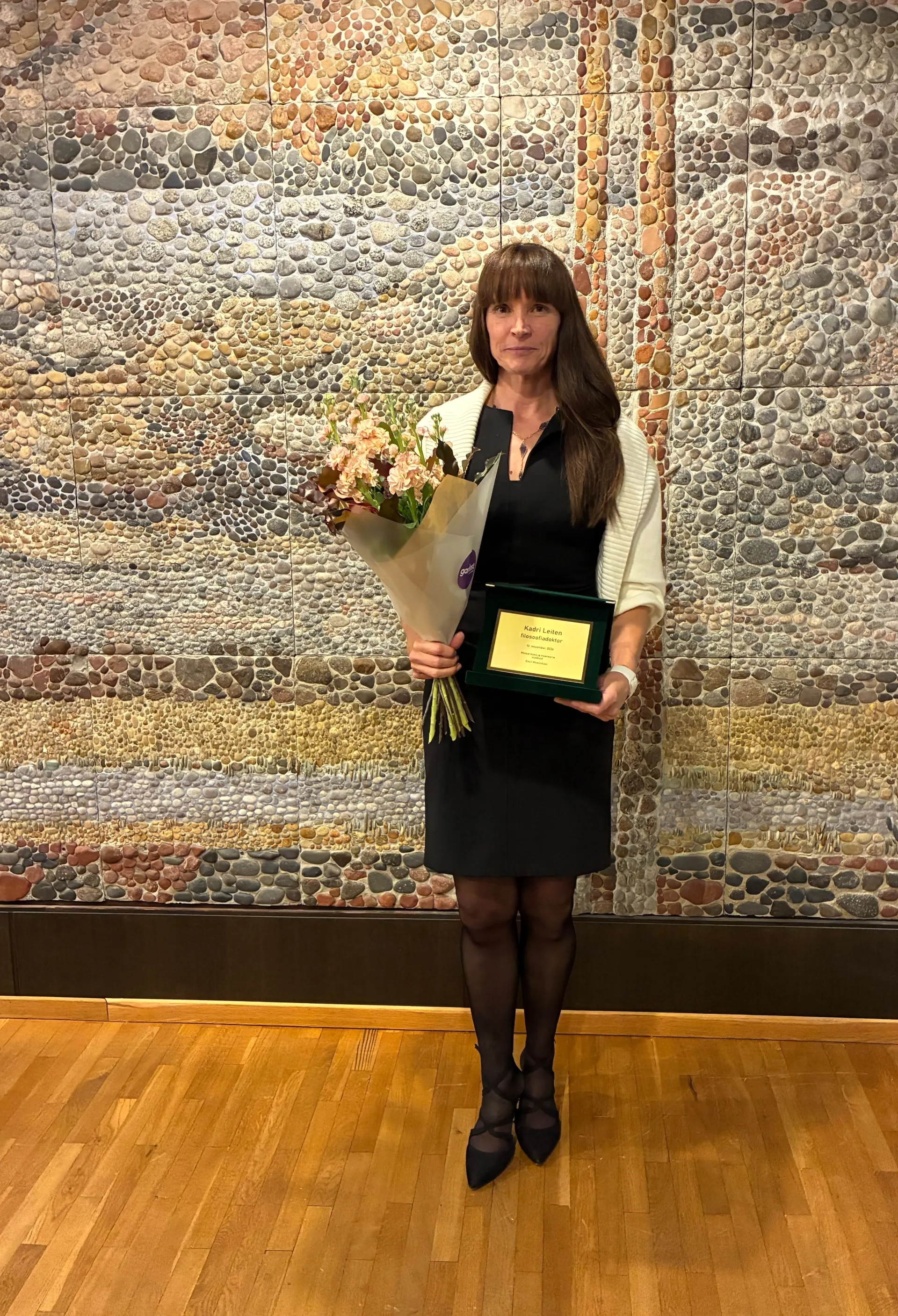
The doctoral thesis was supervised by Dr Marko Teder. The opponents were Associate Professor Evy Vereecken from KU Leuven, Belgium, and Dr Simo Ilomets from Tallinn University of Technology.
Improving the energy efficiency of historic masonry buildings is important, but insulating their walls from the inside can lead to moisture-related damage. Unlike external insulation, internal insulation changes the temperature and moisture conditions within the masonry and may promote moisture accumulation inside the structure. This increases the risk of mould growth, frost damage and material deterioration.
Short-term measurements may not reveal long-term moisture risks
In her doctoral research, Leiten investigated the development of damage risks associated with moisture and soluble salts in historic massive masonry. First, she assessed the ability of different sacrificial plasters to remove salts from field stone walls, where salt accumulation can damage masonry and finishing layers. The results showed that clay-based sacrificial plasters provided the most favourable combination of salt-removal efficiency and ease of removal.
Leiten then investigated the heat and moisture behaviour of brick and field stone walls internally insulated with reed and wood fibre boards. She used both on-site measurements and computer simulations to assess the performance of these structures under historical and projected future climate conditions.
The study revealed that short-term measurements mainly reflect seasonal variations in moisture conditions and may fail to identify long-term problems. Simulations showed that moisture can gradually accumulate over several years in the investigated field stone wall, which contained a moisture-conducting and moisture-storing infill layer between the stone layers. The properties of the materials affected the rate of moisture accumulation but did not eliminate its long-term increasing tendency.
Climate change affects the preservation of historic buildings
The doctoral research showed that conditions favourable for mould growth may persist in internally insulated masonry walls under projected future climate conditions. Although climate warming may reduce the number of freeze–thaw cycles, high moisture levels within the masonry during freezing can still pose a risk of damage.
Leiten's doctoral thesis highlights that short-term measurements alone are insufficient for assessing the long-term performance of internally insulated historic masonry walls. The study demonstrated that when field stone walls containing an internal moisture-conducting and moisture-storing infill layer are insulated from the inside, moisture may accumulate unnoticed over several years. The findings contribute to a better understanding of long-term moisture and damage risks associated with improving the energy efficiency of historic buildings.
The doctoral thesis is available in the digital archive of the Estonian University of Life Sciences EMÜ DSpacelink opens in new page.
Editor:

Research Communication Specialist
Rector's Area of Responsibility
Department of Marketing and Communication
53585680
53585680More information:

Lecturer in Building Physics and Construction
Institute of Forestry and Engineering
Chair of Rural Building and Water Management
+372 7313180
+372 7313180