
On 19 October, Margret Jürison defended her doctoral thesis, “Variation in bumble bee sensitivity to pesticides across intraspecific, exposure and dietary contexts”, at the Estonian University of Life Sciences.
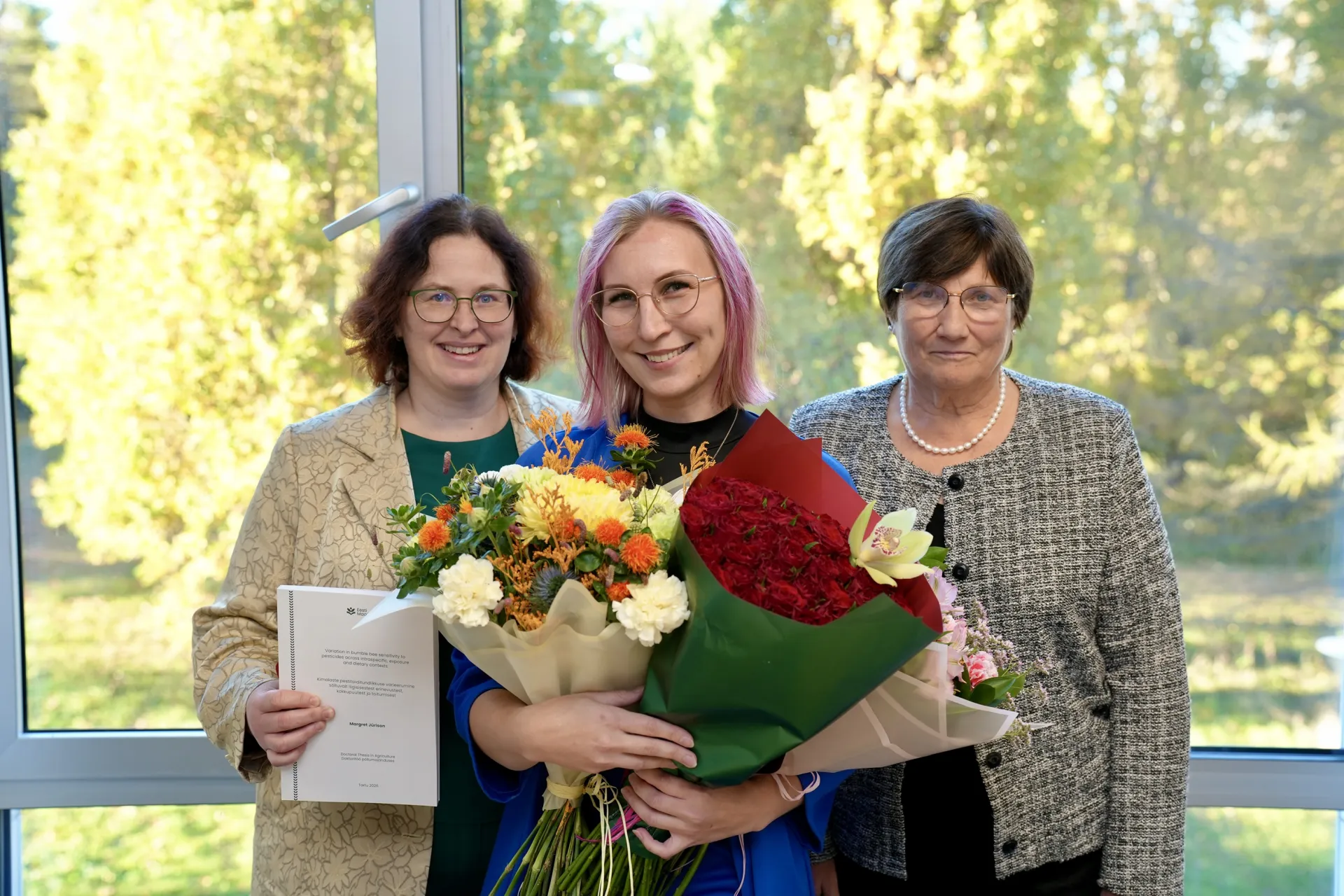
The thesis was supervised by Professor Marika Mänd and Professor Reet Karise. The opponent was Professor Ivo Roessink from Wageningen University & Research.
Pollinators are exposed to various stress factors in agricultural landscapes, with pesticides being among the most significant. However, pesticide risk assessments do not always sufficiently account for the fact that individuals of the same species may respond differently to pesticides. Their effects may also depend on the route of exposure, nutrition and interactions between different pesticides. In her doctoral research, Jürison investigated these factors using the buff-tailed bumblebee (Bombus terrestris) as a model species.
Laboratory experiments assessed the effects of pesticides on workers, males, queens and larvae under different exposure routes and nutritional conditions. The results showed that workers, males and queens differed in their sensitivity to pesticides, and these differences could not be explained by body size alone.
Lower pesticide residue levels do not always mean reduced toxicity
The research revealed that the rate at which pesticides are eliminated from the body and their toxic effects depend on the bumblebee's caste or sex, the pesticide's active ingredient and the route of exposure. In several cases, toxic effects increased even as pesticide residue levels in the body were already declining. This means that residue concentrations alone do not always provide an accurate indication of the severity or duration of a pesticide's effects on bumblebees.
Jürison also investigated the combined effects of two pesticide active ingredients, sulfoxaflor and azoxystrobin. The results showed that their combined effects depended on the dose and route of exposure and were therefore not consistent across all conditions.
Nutrition also influences bumblebee resilience
The study found that the effects of pesticides on larvae also depended on their diet. A diet consisting of pollen from several plant species supported larval development better, while the effects of sulfoxaflor varied depending on nutritional conditions. This demonstrates that nutrition can influence both the severity of pesticide effects and how they manifest in bumblebees.
The findings highlight that pesticide risks to pollinators cannot be assessed solely on the basis of active ingredients and mortality rates. Assessments must also consider the bumblebee's developmental stage and physiological condition, how it is exposed to pesticides and its nutritional conditions. Jürison's research suggests that taking these factors into account in pesticide risk assessments would help identify potential risks more accurately and support pollinator conservation.
The doctoral thesis is available in the digital archive of the Estonian University of Life Sciences, EMÜ DSpacelink opens in new page.
Editor:

Research Communication Specialist
Rector's Area of Responsibility
Department of Marketing and Communication
53585680
53585680More information:

Chief Specialist in Plant Health
Institute of Agricultural and Environmental Sciences
Chair of Plant Health
